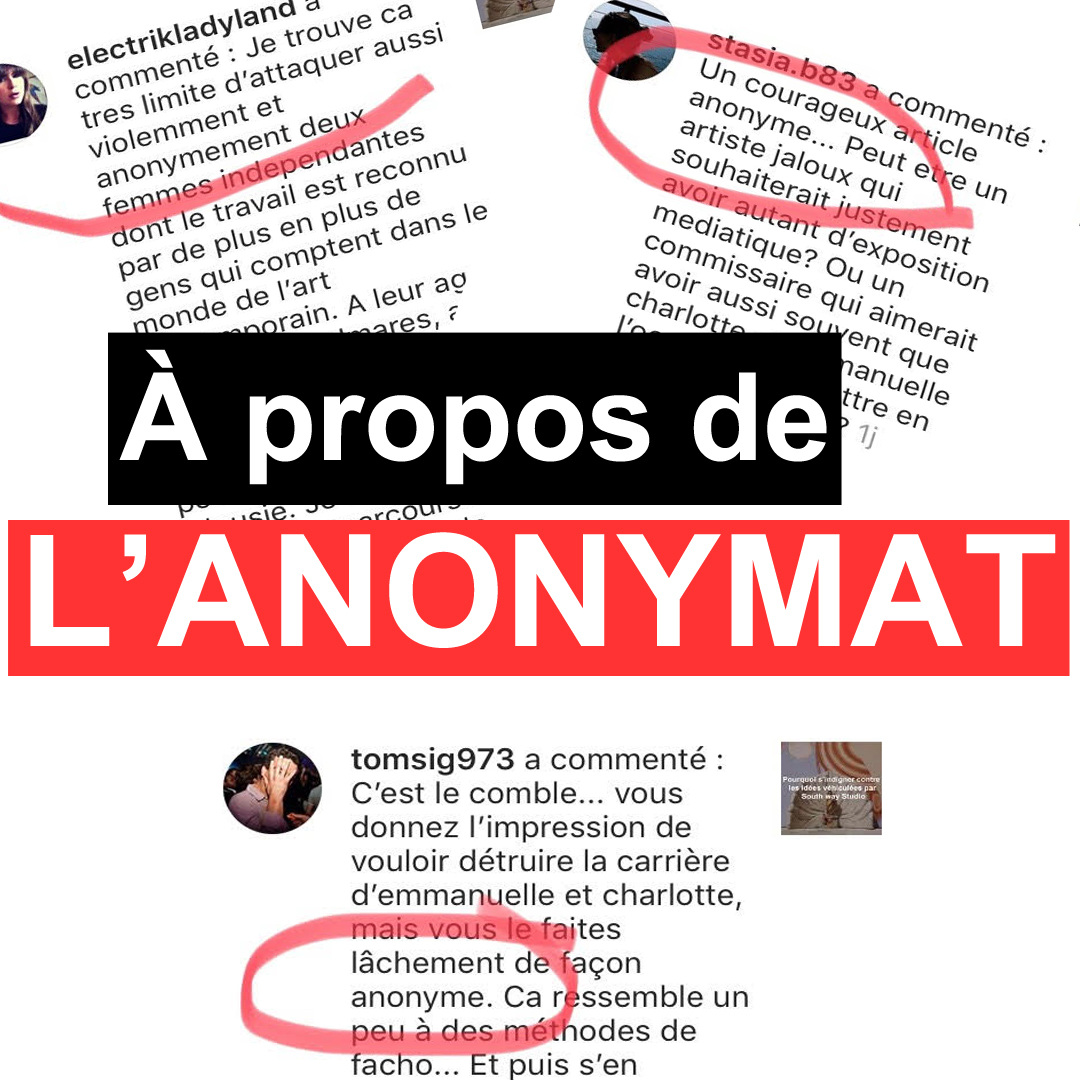
Anonymity is a strategy used by many authors to express themselves freely on certain issues deemed subversive by the authorities or a given circle (denunciation of abuses of power, situations of violence emanating from institutions and dominant people, hate speech, compromising relationships, etc.). Anonymity is used to guarantee freedom of speech and minimise the risk of sanctions, whether legal, professional, or interpersonal, but does not prevent them.
In his book Domination and the Arts of Resistance (1990) the American anarchist and political scientist James C. Scott distinguishes « hidden text » and « public text ». He devises a template to think about dominant relationships: « Any dominated group produces, by virtue of its condition, a « hidden text » under the eyes of the dominant, which represents a critique of power. Dominants, on their sides, also develop a hidden text involving the practices and underpinnings of their power, which cannot be publicly exposed. »
Duplicity is the rule, but James C. Scott shows the conditions that can disrupt it.
One of them consists in the use of anonymity, where the messengers are masked, but the criticism, the message, can nevertheless be direct and unambiguous.
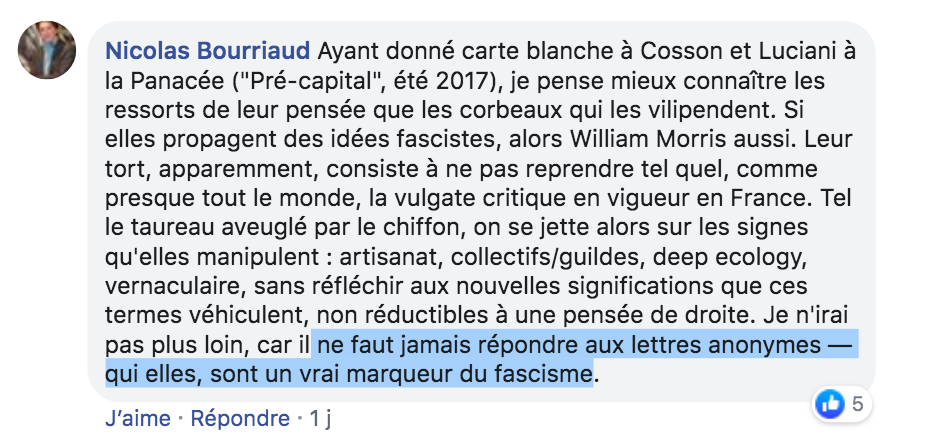
For example, when Nicolas Bourriaud, previously director of the Palais de Tokyo and the Beaux Arts de Paris, currently director of the Mo.Co and curator of the Istanbul 2019 Biennale, rises up against the authors of yesterday’s text on Documentations, notably because of its anonymity, one can wonder about the nature of the power relationship that exists between Nicolas Bourriaud and the voices that would challenge his authority. We could ask ourselves: when a debate involves Nicolas Bourriaud in the French art world, who except Nicolas Bourriaud himself can take on to express himself brazenly ?
If you are interested in the issue of anonymity in a context of domination, please refer to the literature recommended below:
– Geoffroy de Lagasnerie, The Art of Revolt. Snowden, Assange, Manning. Stanford University Press, 2017.
– Annika Bender, Death of an Art Critique, 2017, Sternberg Press, 96p.
– Yaman Akdeniz, « Anonymity, Democracy, and Cyberspace » in Social Research, (2002) 69(1), Spring, pp 180-194.
– Hans Asenbaum, « Anonymity and Democracy: Absence as Presence in the Public Sphere » in American Political Science Review, Volume 112, Issue 3, August 2018, pp. 459-472